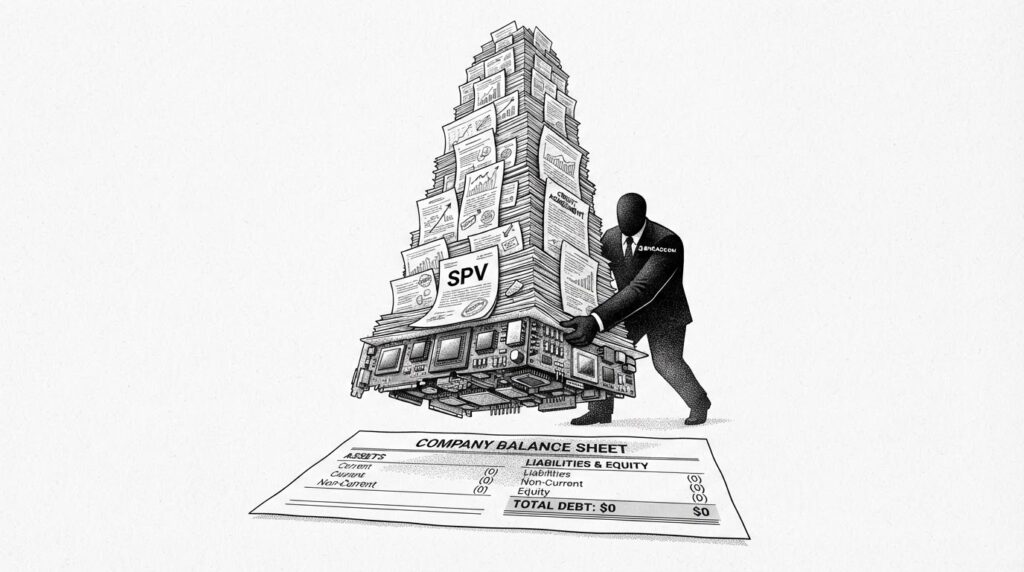
The headline figure is $71 billion in chip-lease debt secured in roughly 60 days, but the true story of Anthropic’s recent capital expansion lies in the mechanics of the special purpose vehicle. By utilizing these structured finance vehicles, Anthropic has sequestered massive hardware deployments entirely off its corporate balance sheet. This is not corporate debt — it is off-balance-sheet leasing that allows the company to scale its compute capacity without the drag of hardware depreciation on its primary financial statements.
The structure relies on a critical credit enhancement: the Broadcom residual value backstop. In the $35 billion deal closed in June 2026, arranged by Apollo Global Management and Blackstone Credit and Insurance, the SPV acquires Google’s tensor processing units and leases them back to Anthropic. The senior tranches — specifically the approximately $6 billion Senior A1 notes and the approximately $24 billion Senior A2 notes — carry a Broadcom endorsement. If Anthropic defaults on its lease payments or if the resale value of the hardware falls short, Broadcom covers the gap. Consequently, these senior tranches functionally carry Broadcom’s investment-grade credit rating rather than Anthropic’s. The $4.5 billion Class B tranche, which carries no Broadcom support, trades at roughly 8.5 percent — a spread that reveals exactly how much value the backstop removes from the equation. This mechanism is the linchpin that makes $71 billion in private credit accessible to a company still in a cash-burning growth phase, with a $19 billion annualized revenue run rate against estimated compute spending of approximately $45 billion per year.
The market is watching for Anthropic’s October 2026 IPO debut — a confidential S-1 filed June 1 with Morgan Stanley, Goldman Sachs, and JPMorgan leading the underwriting, targeting a public-market valuation anchored at the $965 billion post-money established by its $65 billion Series H raise. But it is essential to distinguish between two parallel capital structures. The IPO raises equity capital for corporate operations. The SPVs raise debt against hardware. These are two separate engines funding the same aggressive compute expansion, and the SPV debt is structurally invisible to public-market investors evaluating the equity story.
The preliminary $36 billion deal Bloomberg reported in early August 2026 follows this same blueprint. Blackstone is leading early investor talks on a second mega-debt package, with deployment targeted at data centers across New York, Texas, Louisiana, and Indiana. The terms are preliminary and subject to change, but the structure mirrors the first deal: SPV acquires TPUs, leases to Anthropic, Broadcom backstops the senior slices. If finalized, Anthropic’s total structured-credit exposure to Google hardware alone would exceed $71 billion — among the largest private-credit arrangements ever assembled.
Compute Landlord Thesis, Part Four. We have traced this thesis through increasingly large financial structures: the $10 billion Volta Infra contract that demonstrated a $2.4 billion company can anchor a $10 billion commitment from a nearly trillion-dollar lab; the equity-funded $100 billion-plus scale of SpaceX’s 10 GW initiative; and Nvidia’s $600 billion in vendor-financed compute exposure to OpenAI. Anthropic’s approach is the credit-funded iteration. The Samsung-Broadcom $200 billion supply chain deal shows the hardware side hardening in parallel. Whether through equity, vendor financing, or structured credit, the objective is identical: securing the scarce resource. Anthropic’s ability to access $71 billion in private credit in two months — by borrowing Broadcom’s balance sheet rather than its own — demonstrates that the funding mechanism is now as important as the hardware it purchases.