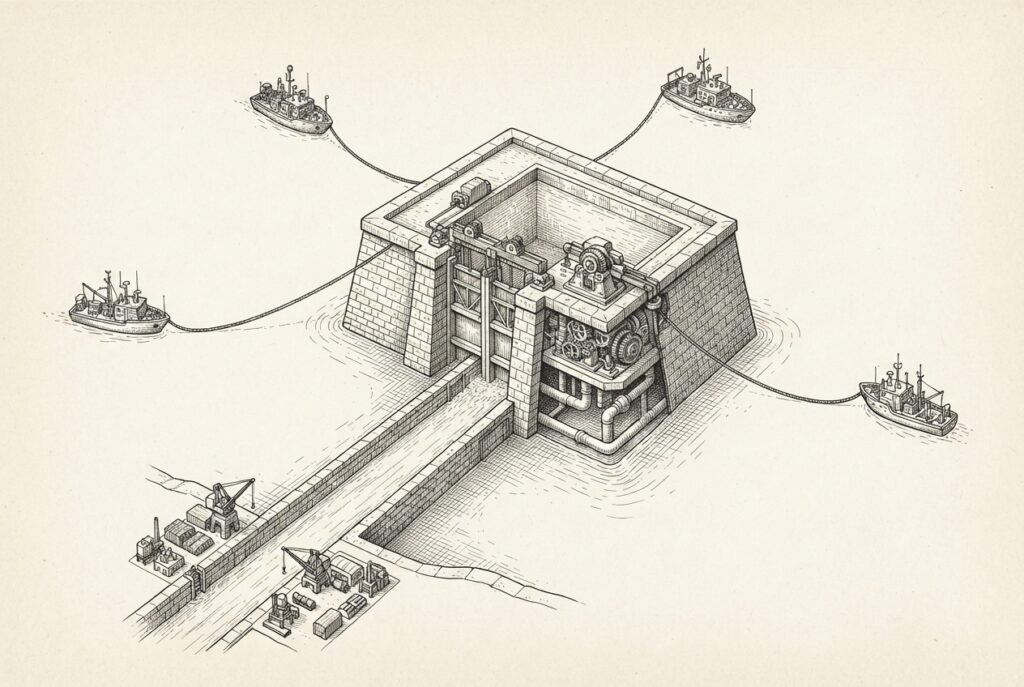
Google is executing a fundamental architectural shift in how it manages the tension between high-stakes product delivery and long-horizon research. By consolidating DeepMind under a product-focused mandate while simultaneously spinning out its most ambitious scientific talent into a separately funded entity, the company is effectively adopting a compute landlord model. This strategy prioritizes the immediate, iterative demands of the Gemini product cycle while offloading the capital-intensive, high-risk burden of foundational research to an externalized structure.
The leadership shakeup announced on August 5, 2026, marks the end of an era. Demis Hassabis, previously CEO of DeepMind, has been elevated to the newly created role of Alphabet Chief Scientist and DeepMind Chair, a move framed by CEO Sundar Pichai as a way to focus on the future of AGI. Meanwhile, day-to-day operations shift to SVP Koray Kavukcuoglu, who now leads Gemini model development, frontier AI research, and the associated application teams. This is a clear signal: DeepMind is no longer a research laboratory with a product arm; it is a product engine with a research legacy.
The most striking evidence of this pivot is the departure of four foundational machine learning scientists — Jeff Dean, Sanjay Ghemawat, Oriol Vinyals, and Quoc Le — to form Discovery Loop. The loss of Dean, a 27-year veteran and co-founder of Google Brain, is a profound signal of the internal friction between corporate product timelines and the desire for unconstrained scientific inquiry. By moving these individuals into a Delaware Public Benefit Corporation backed by venture capital firms like Radical Ventures and Khosla Ventures, Google is de-risking its balance sheet. It retains a stake as a founding investor and secures its position as the exclusive cloud partner, ensuring that whatever breakthroughs Discovery Loop achieves, the compute infrastructure remains firmly under Google’s control.
Discovery Loop’s mission — to automate scientific and engineering research across fields like chip design, biology, and materials science through thousands of automated experimental loops in parallel — represents the kind of high-burn, long-horizon work that often struggles to survive the quarterly scrutiny of a public company. By externalizing this, Google avoids the direct P&L impact of these moonshots while maintaining a first-look advantage. It is a sophisticated hedge: if the research succeeds, Google captures the value through its cloud dominance and equity stake; if it fails, the venture capital market absorbs the loss.
The context matters. Delays to the planned June launch of Gemini have intensified market anxiety that Google is losing ground to OpenAI and Anthropic. Alphabet shares fell 4-5% on the announcement, reflecting investor skepticism about the company’s ability to balance its massive infrastructure investments with the agility required to win the current open-weights and closed-model capability wars. The market is weighing the execution risk of a product-centric DeepMind against the potential loss of the company’s long-term research edge.
The compute landlord thesis suggests that in the AI era, the entity that owns the infrastructure holds the ultimate leverage. Google’s move externalizes the research vision while keeping the high-risk innovation ecosystem tethered to its own data centers. It does not need to own the researchers to own the results — it needs to own the compute those researchers cannot function without.
What makes this structurally different from a typical corporate reorganization is the specific configuration: Google is not just losing talent to the market. It is funding the departure vehicle, providing the cloud infrastructure, and retaining an equity stake. The four departing scientists are among the most cited ML researchers alive. Google is simultaneously acknowledging that it cannot retain them inside a product-focused hierarchy and ensuring that their work still flows through Google’s pipes.
The question for investors is not whether this consolidation will improve Gemini’s competitive position against Claude, GPT-5.6, or Qwen3.8-Max — it might. The question is whether Google has decided that owning the infrastructure layer is more durable than owning the research layer. If Discovery Loop’s automated scientific loops succeed, the breakthroughs will be trained on Google’s cloud. If they don’t, the cost was borne by Radical Ventures, Khosla, and the other seed investors. Google is betting that the only constant in an industry where research vision is increasingly mobile is the compute that vision cannot escape.