On August 1, 2026, Meta Business Agent will transition from a free testing phase to a commercial model priced at $2.00 per million tokens. This is not merely a change in billing; it is a structural signal that the pricing frontier for agentic commerce is shifting from human headcount to AI output volume.
For years, enterprise software economics were anchored to the per-seat model. It was predictable, scalable, and tied to the growth of human teams. However, as BCG research indicates that 43% of US jobs are crossing the 40% task-automation threshold, the per-seat model has become an increasingly poor proxy for value. Companies like Monday.com have already begun to acknowledge this friction, shifting in May 2026 from traditional per-seat SaaS to a hybrid model centered on AI credits. This transition reflects a broader industry realization: when software performs the work, charging for the person using it makes less sense than charging for the work itself.
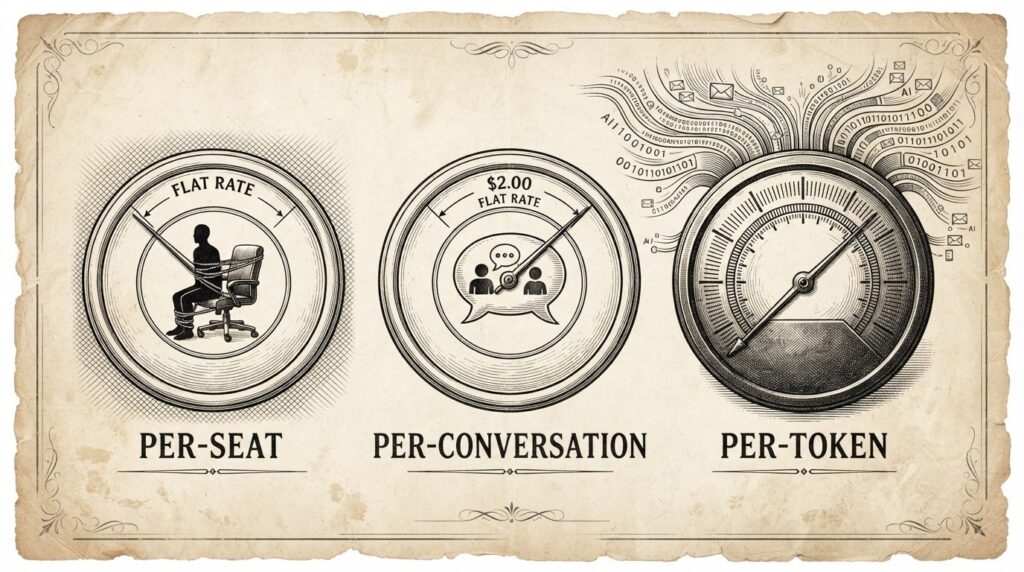
Pricing architectures are currently bifurcating into three distinct models: the legacy per-seat structure, which struggles to maintain relevance in automated workflows; the per-conversation model, exemplified by Salesforce Agentforce, which charges a flat $2.00 per interaction; and the per-token model now adopted by Meta.
Meta’s model, which bundles AI processing and message delivery into a single blended rate, creates a 40-50x price advantage over the Salesforce per-conversation approach. With a typical interaction consuming 20,000 to 25,000 tokens, a 10-turn conversation on Meta’s infrastructure costs roughly $0.40 to $0.50. By comparison, the same volume of interaction under a flat-fee per-conversation model would cost $2.00. For enterprises managing high-volume customer engagement — Meta reports over 1 billion active business conversation threads daily — this delta is not a rounding error; it is a fundamental shift in operating margins.
The dual-billing mechanism introduces significant complexity. On October 1, 2026, Meta will resume per-message charges for service messages within the 24-hour window, effectively ending the period of free human replies. This creates an overlapping cost structure where enterprises must navigate charges for both intelligence (tokens) and delivery (service messages). This complexity is likely to test the patience of IT departments already struggling to justify the ROI of their deployments.
Gartner projects that more than 40% of enterprise agentic AI projects will be abandoned by the end of 2027. The primary driver of this failure is often the mismatch between the cost of AI output and the actual value generated by the agent. While Meta’s pricing is aggressive, it remains unproven whether the efficiency gains of token-based automation will consistently outweigh the operational overhead of managing these new, fragmented billing models.
The era of software pricing tied to employee headcount is concluding. The new frontier is defined by the volume of tokens processed and the efficiency of the underlying model. Whether this shift leads to sustainable enterprise value or a wave of abandoned projects will depend on whether companies can successfully map their AI output costs to tangible revenue, rather than simply replacing human headcount with a new, more complex line item.