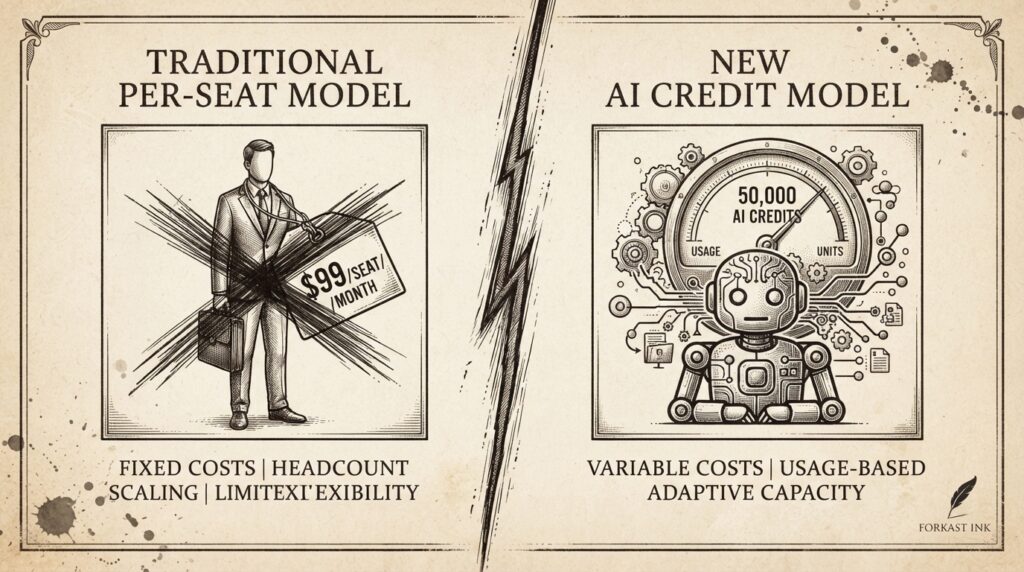
Monday.com has fundamentally altered its revenue model, moving away from a strictly per-seat SaaS subscription to a hybrid structure that blends seat-based access with AI credit consumption. Formalized in May 2026, this shift forces enterprise decision-makers to account for a new variable in their software budgets: the automated output generated by AI agents. Under the new tiered system, Basic plans include 1,000 credits, Standard plans 2,000, and Pro plans 3,000. Usage beyond these bundles is billed at $0.01 per credit on yearly plans or $0.0125 on monthly plans, marking a transition from paying for human headcount to paying for the orchestration of autonomous tasks.
This strategic pivot from a “Work OS” to an “AI Work Platform” was announced on May 6, 2026. Co-CEO Roy Mann framed the change as a necessary evolution for the company’s 250,000+ enterprise customers, stating: “Our customers are running real businesses in a world that’s changing fast, and they need a platform built for that reality.” The platform now features native AI agents that allow non-technical team members to configure workflows with one-click connectors to Anthropic, Microsoft, and OpenAI.
The transition has been accompanied by significant organizational friction. On July 22, 2026, as reported by TechCrunch, Monday.com announced it would cut approximately 620 to 630 employees, or 20% of its global workforce. This action aligns with a broader 2026 trend identified by Layoffs.fyi, where 78% of companies cited an AI refocus as a primary driver for workforce reductions. Despite the $45-55 million in restructuring charges, leadership insists the move is a strategic realignment rather than a cost-cutting measure. CEO Eran Zinman addressed the tension directly: “Improving margins was not the purpose of this decision… this decision was not made to reduce costs or replace people with AI. This change was made to adapt the company to our new vision.”
Investors have responded positively to this aggressive pivot. Following the announcement of the restructuring and the new AI-first strategy, Monday.com’s stock rose approximately 12.6%. This market reaction is particularly notable given that the company’s shares had fallen more than 50% since the start of 2026, leaving its market cap at roughly $3.1 billion prior to the news. By reaffirming revenue growth guidance at 19-20%, the company is attempting to signal that its future value is no longer tethered to traditional SaaS growth metrics, but to its ability to scale as an AI-driven engine.
This shift aligns with the BCG framework on the stages of AI adoption, where the focus moves from simple task automation to the orchestration of complex, multi-agent workflows. As Monday.com integrates these capabilities, it reinforces the “Agents at Work” thesis: software platforms are becoming the connective tissue between human intent and autonomous execution. For enterprise buyers, this creates a new operational reality. Procurement teams must now prepare for software budgets that are increasingly volatile, tied to the unpredictable consumption of AI credits rather than static seat counts.
As other SaaS companies observe Monday.com’s experiment, the industry is likely to see a broader move toward variable-cost automation engines. Enterprise decision-makers are no longer just purchasing access to a tool; they are buying a capacity for automated output. Consequently, the ability to measure the ROI of an AI agent—distinct from the productivity of the human user—will become the defining challenge for the modern workplace. The transition is not merely a pricing update; it is a fundamental recalibration of how enterprise software delivers value in an automated economy.