As enterprise security teams brace for the August 3 public preview of Microsoft’s Project Perception, the focus is shifting from general-purpose large language models to specialized, agentic security architectures. The upcoming release marks the first time the public will gain access to the company’s MAI-Cyber-1-Flash, a model designed exclusively for cybersecurity tasks, operating within the broader Multi-Model Agentic Scanning Harness (MDASH) pipeline.
At the July 27 launch event in San Francisco, CEO Mustafa Suleyman framed the development as a necessary evolution in automated defense, noting that “the complexity of modern attack surfaces requires a departure from static scanning.” EVP Hayete Gallot further emphasized the platform’s operational role, stating that “the model is not merely a chatbot, but a functional component of a larger, automated security ecosystem.” The model is currently restricted to the MDASH environment, meaning it will not be available as a standalone API, a decision that underscores Microsoft’s strategy to control the integration of its agentic security stack.
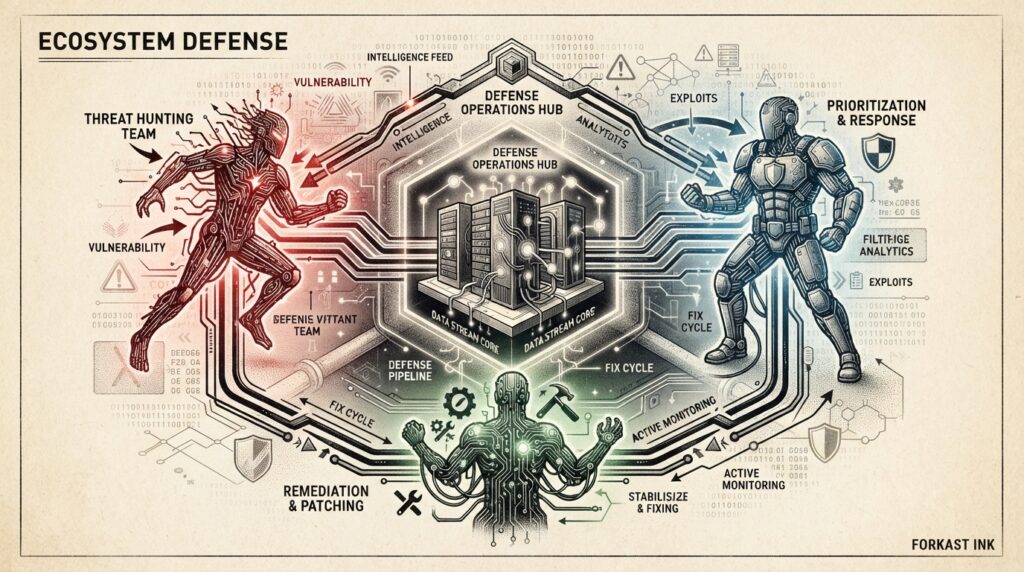
The technical architecture of MDASH is built around a pipeline of over 100 specialized agents, structured into four distinct stages: prepare, scan, validate, and dedupe. This pipeline is further augmented by Project Perception, which organizes agents into Red, Blue, and Green teams. In this framework, Red team agents actively hunt for attack paths, Blue team agents prioritize risks, and Green team agents execute the necessary fixes. This tiered approach is designed to reduce the noise typically associated with automated vulnerability scanning, a point echoed in recent industry analysis from Noma Security.
Microsoft has made aggressive claims regarding the performance of MAI-Cyber-1-Flash, reporting a 95.95% score on the CyberGym benchmark. According to the company, this represents a 12-point lead over Anthropic’s Mythos 5. It is critical to note that these figures are vendor-reported and have not been independently verified. While the model is reported to handle 90-95% of routine vulnerability identification work, its real-world efficacy remains to be tested by the broader enterprise community. During a limited private preview that began in May 2026, the MDASH pipeline reportedly identified 16 new vulnerabilities, including four critical Remote Code Execution (RCE) flaws within the Windows networking and authentication stack.
The competitive landscape for cybersecurity-specific AI is intensifying, with coverage from outlets like GeekWire and Axios highlighting the stakes. Microsoft is positioning MAI-Cyber-1-Flash against high-profile rivals, including Google’s Gemini 3.5 Flash Cyber-currently restricted to government use-Anthropic’s Mythos 5, and the cybersecurity capabilities integrated into OpenAI’s GPT-5.6 Sol. Microsoft is also leveraging a cost-based argument, claiming its model operates at roughly half the cost of these competing systems. For complex tasks, the system is designed to pair with GPT-5.4, ensuring that the specialized model is supported by broader reasoning capabilities when necessary.
The reliance on vendor-reported benchmarks necessitates a degree of skepticism from enterprise decision-makers. While Microsoft states that the model has been evaluated by its internal AI Red Team and subjected to both automated and expert-led adversarial exercises, the lack of independent, third-party validation means that the true performance delta remains an open question. The industry will be watching closely to see how the model performs once it moves from the controlled environment of the private preview to the varied, messy realities of enterprise networks.
As the August 3 preview approaches, the significance of this launch lies in the shift toward agentic, multi-model security pipelines. If the MDASH architecture can consistently deliver on its promise of automating the identification and remediation of critical vulnerabilities, it could fundamentally alter the economics of enterprise security. However, the success of Project Perception will ultimately depend on its ability to integrate seamlessly into existing workflows without introducing new, unforeseen attack vectors of its own.