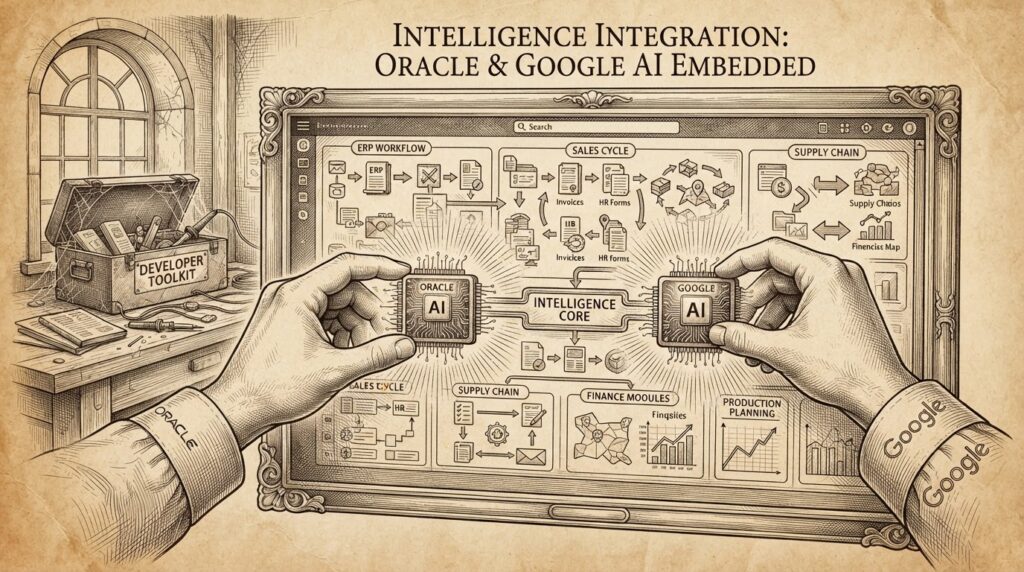
Oracle AI Agent Studio has offered model choice since at least October 2025 — OpenAI, Anthropic, Cohere, Meta, xAI, and Google are all on the menu. So when Oracle and Google Cloud announced an expanded partnership on July 30, the obvious reading — another model joins the list — misses what actually changed.
What changed is where the intelligence lives. Oracle is not just making Gemini available through its developer tools or cloud infrastructure, which it has done through Oracle Cloud Infrastructure Enterprise AI since August 2025. It is planning to embed Gemini 3.1 Flash-Lite and Gemini 3.5 Flash directly into Fusion Applications and NetSuite — the ERP, HCM, supply chain, and CRM systems that run daily operations at more than 14,000 organizations globally. NetSuite alone reaches over 44,000 customers across 220 countries.
That is a different kind of move. Instead of giving developers another model to wire into custom workflows, Oracle is making Google’s AI a standard component of the business process itself. The difference matters because the deployment gap in enterprise AI is not mainly about model access — it is about the friction of getting models from a prototype into production. Eighty percent of enterprises embed AI somewhere; only 31 percent ship it into workflows that matter. Embedding at the application layer, rather than the infrastructure layer, is the most direct way to close that gap.
The infrastructure for this kind of deep integration has been maturing. Oracle’s Fusion Applications already support the Model Context Protocol and Agent-to-Agent communication as of Release 26A, giving agents a standardized way to connect with external tools and with each other. Those protocols created the plumbing. Now the platform layer is responding by pulling the models closer to the workflows they are supposed to automate.
The deal is also a competitive signal. Salesforce has Agentforce. ServiceNow has Now Assist. Every major enterprise platform is racing to own the agent layer, and the ones that embed AI most natively — rather than offering it as an add-on — have the advantage when execution failures, not hallucinations, are what kill deployments. A model that runs inside the ERP workflow, governed by the same approvals and access controls, fails differently than one bolted on from the outside.
Satish Thomas, VP of Google Cloud, framed the partnership as a distribution play:
Organizations around the world trust Google Cloud’s full AI stack to power critical enterprise workflows and agents. Our expanded partnership with Oracle is designed to make it easier for organizations to use Gemini in the applications and agentic workflows they rely on to automate workflows, accelerate decisions, and drive outcomes.
Kevin Ichhpurani, President of the Global Partner Ecosystem at Google Cloud, made the same point more directly:
Our partnership with Oracle brings Google’s most capable AI models directly into the core application workflows global businesses rely on every day. Together, we are making it seamless for enterprises to apply powerful and cost-efficient AI directly where business decisions happen.
For Oracle, the framing is about model flexibility within governed workflows. Chris Leone, EVP of Oracle, said:
To achieve the best business outcomes, organizations need the flexibility to choose the AI model best suited to each problem. By bringing Gemini to Oracle AI Agent Studio for Fusion Applications, we are giving customers and partners greater choice as they build and extend agents and agentic applications that reason through complex, real-world business challenges.
Evan Goldberg, founder and EVP of NetSuite, connected it to the mid-market:
AI is at the core of how customers use and experience NetSuite and choosing the right model for the right use case is critical to helping them get more value from AI. As we evaluate various AI use cases in NetSuite, we are working with leading large language models, like Google’s Gemini, to help customers improve visibility, automate work, and move from insight to action within NetSuite.
One caveat: this integration is planned, not live. Oracle included a future product disclaimer, which means the actual performance of Gemini inside enterprise workflows is still unproven. The vision is clear — embed AI where the work happens — but the execution will determine whether this is a genuine deployment accelerant or another announced-but-delayed enterprise AI feature.
The market treated it as significant. Oracle stock rose 3.3 percent on the day, with an intraday high of 8.4 percent. The enterprise AI agent platform market is projected to grow from $7.8 billion in 2025 to $68.4 billion by 2034, according to industry forecasts. Both companies are positioning to capture that growth by moving intelligence from the developer console into the applications enterprises already depend on.