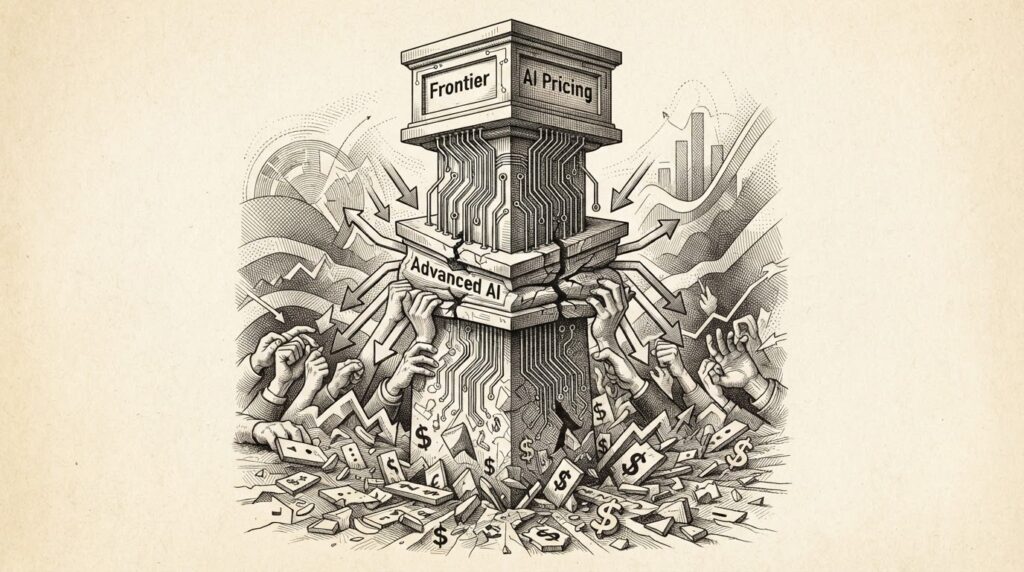
On July 30, 2026, OpenAI executed a sharp recalibration of its model pricing, slashing the cost of its GPT-5.6 Luna tier by 80%. The price for Luna, the fastest and most cost-effective model in the GPT-5.6 lineup, dropped from $1/$6 to $0.20/$1.20 per million input/output tokens. This aggressive move, reported by CNBC, arrives just three weeks after the initial launch of the GPT-5.6 family on July 9, 2026, signaling that the pricing power of frontier AI labs is facing significant erosion under the weight of global competition.
To understand the market mechanics at play, one must look at the tiered structure of the GPT-5.6 release. The lineup consists of Sol, the flagship model representing maximum capability; Terra, the balanced middle tier; and Luna, which offers approximately 85% of Sol’s quality. While Luna saw an 80% reduction and Terra received a 20% cut – moving from $2.50/$15 to $2/$12 per million tokens – the flagship Sol model remained unchanged at $5/$30 per million tokens. This divergence is telling: OpenAI is holding the line on its premium, frontier-grade intelligence while aggressively defending its mid-tier market share.
The catalyst for this defensive posture is increasingly clear. A CNBC investigation published on July 7, 2026, revealed that Chinese models have captured 46% of US enterprise token usage on OpenRouter, at times peaking above US-origin models. This shift in volume is not merely a matter of preference; it is a matter of economics. DeepSeek V4 Pro, for instance, is priced at $0.435/$0.87 per million tokens, benefiting from a standing 75% promotional discount. Kimi K3, another prominent Chinese model, sits at $3/$15 per million tokens. By pricing Luna at $0.20/$1.20, OpenAI has effectively undercut DeepSeek on input costs, though it remains more expensive on output tokens. This is a direct response to the growing enterprise sensitivity to AI costs, where the utility of a model is increasingly weighed against its per-token overhead.
Industry competitors are navigating this landscape with varying pricing models. Anthropic’s Fable 5 remains priced at $10/$50 per million tokens, while its Sonnet 5 model is currently in an introductory phase at $2/$10, set to rise to $3/$15 after August 31. OpenAI’s decision to leave Sol untouched while gutting the price of Luna suggests a dual-track strategy. The company is attempting to maintain its status as the provider of the most capable frontier models while simultaneously commoditizing the utility tier to prevent further leakage of enterprise volume to international competitors.
Furthermore, OpenAI is experimenting with how it segments its user base. Alongside these price cuts, the company offers an API Fast service tier, which charges 2x the standard price for up to 2.5x faster processing. While this tier primarily applies to the Sol model, it demonstrates a clear intent to monetize speed as a distinct product feature, separate from the raw intelligence of the model itself. This allows OpenAI to extract higher margins from latency-sensitive enterprise applications while keeping the base price of its models competitive enough to retain volume.
The rapid commoditization of the mid-tier AI market is now evident. When a flagship lab like OpenAI is forced to reprice its secondary models by 80% less than a month after launch, it confirms that the barrier to entry for high-quality, low-cost inference has collapsed. The question for the market is no longer just about who has the smartest model, but who can sustain the lowest cost-per-token without sacrificing the enterprise-grade reliability that keeps corporate clients from migrating to cheaper, foreign-hosted alternatives. OpenAI’s latest move is a clear admission that in the current environment, capability alone is no longer a sufficient moat.