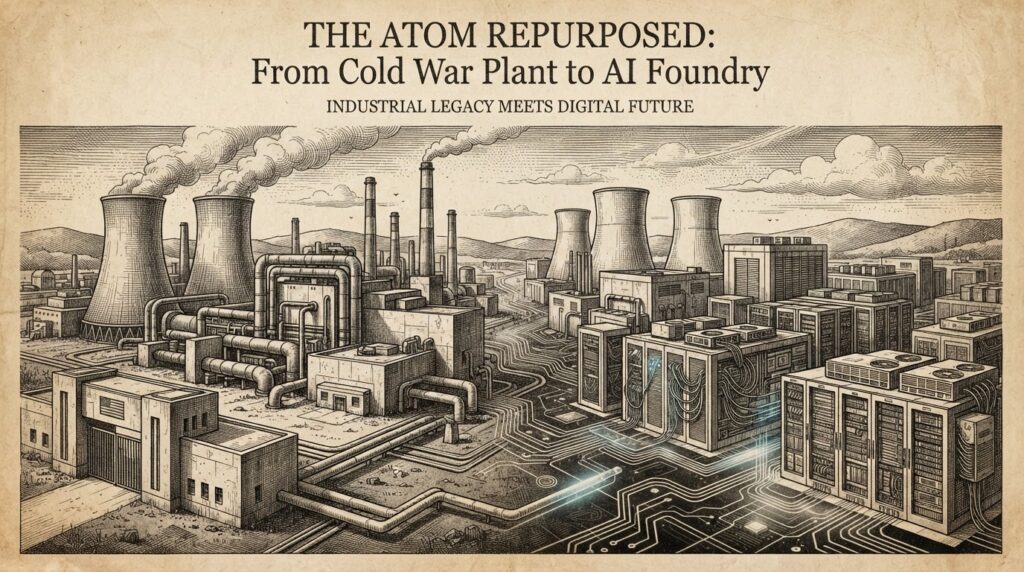
The Department of Energy’s conversion of the 3,556-acre Paducah Gaseous Diffusion Plant into the $100 billion Paducah American Energy Hub signals the end of the era where AI infrastructure developers were forced to compete for scarce private land. For decades, this site in McCracken County, Kentucky, served as a cornerstone of national security, first producing TNT during World War II and later enriching uranium for military reactors and nuclear weapons. Today, the DOE is repurposing this industrial legacy not for defense, but for the compute-heavy demands of the artificial intelligence era.
This project establishes a sovereign-land thesis that distinguishes it from standard private-sector compute landlord plays. Unlike developers who must navigate complex land acquisition and zoning, Brookfield and NextEra Energy are leasing federal land directly from the DOE. By utilizing a site already under federal control, the government is not merely facilitating development; it is actively converting its own decommissioned assets into the backbone of the nation’s AI capacity. This direct state-to-private partnership creates a unique structural model where the federal government provides the physical footprint, while private capital assumes the development and operational risk.
The financial architecture of the Paducah hub is built on a strictly private-funding model, with no federal dollars involved in the $100 billion investment. The project relies on a ‘bring-your-own-power’ strategy, with NextEra Energy tasked to build and own 4.6 gigawatts of dedicated generation infrastructure, comprising 2 gigawatts of natural gas and 2.6 gigawatts of battery storage. This approach aligns with the Trump administration’s March 2026 Ratepayer Protection Pledge, which mandates that hyperscalers bear the full cost of power infrastructure to ensure that no financial burden is passed to residential or small-business ratepayers. By internalizing these costs, the project aims to bypass the grid-capacity friction that has stalled other large-scale data center developments.
When compared to other major compute initiatives, the Paducah model stands apart. OpenAI’s Project Camellia, for instance, operates on private land with a $20 billion investment. The AIP/Aligned $40 billion project involves a sovereign-backed consortium but relies on private land acquisition. Meanwhile, the Nvidia/OpenAI Ohio project, with its $250 billion guarantee, remains entangled with state-level power infrastructure. Paducah’s advantage lies in its pre-existing industrial utility: the site was historically engineered to consume 3,000 megawatts of TVA power, 30 million gallons of water per day, and 300,000 pounds of steam per hour. This legacy infrastructure provides a ready-made foundation for the planned 1.8 gigawatt utility capacity and 1.2 gigawatt compute load by 2032.
The Paducah model validates a new compute landlord thesis: the most efficient path for massive AI infrastructure is the state-sanctioned conversion of federal industrial sites. This strategy effectively offloads the burden of site selection and utility integration from the private sector to the state, while maintaining private ownership of the compute assets. It mirrors the broader capex acceleration seen in the industry, where the race for compute capacity is increasingly driving firms to seek out sites with sovereign-level power access.
However, the project remains in its early stages. There is currently no anchor AI customer disclosed, no construction start date has been announced, and the entire transaction remains subject to the negotiation and execution of definitive documentation. Furthermore, while the 4.6 gigawatt generation capacity is substantial, it is a nameplate figure rather than firm capacity; the campus will necessarily remain dependent on the interconnected grid during periods of peak stress or generation shortfall.
The Paducah American Energy Hub forces a binary outcome for the future of AI infrastructure: either the federal government successfully unlocks its vast, dormant industrial portfolio to bypass private-market grid constraints, or the project stalls under the weight of its own complexity. Investors and operators must now determine if the sovereign-land utility model can be scaled across the federal estate, or if Paducah will remain a singular, high-stakes anomaly in the race for compute dominance.