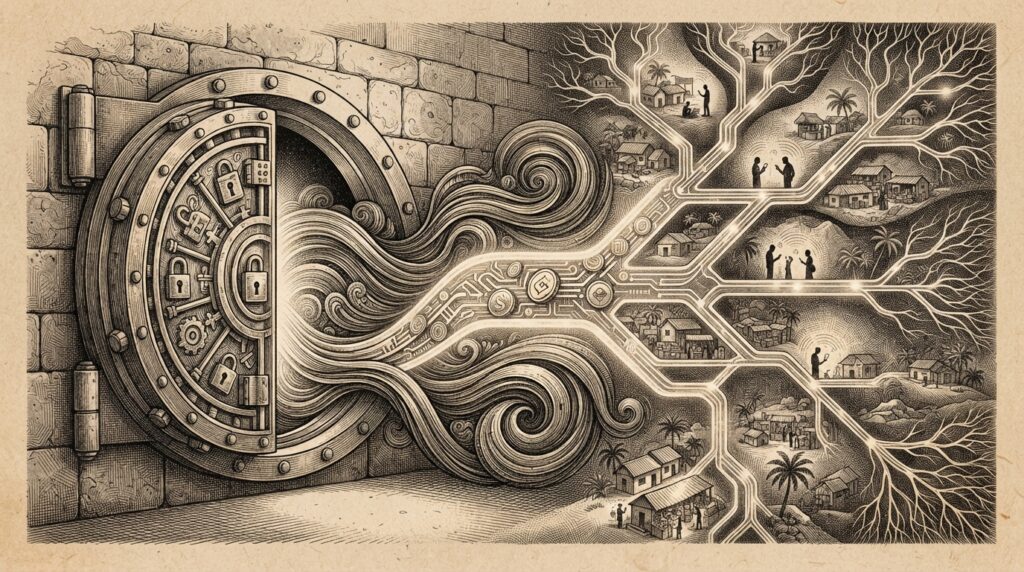
Tether’s launch of its GENIUS Act-compliant USAT stablecoin on the Celo blockchain is not a product play; it is a calculated distribution play. By deploying on a network that already handles approximately 28% of cross-chain USDT transfers, Tether is prioritizing the expansion of its regulated footprint over the introduction of novel financial primitives. This deployment marks a pivot in Tether’s strategy – existing liquidity over ecosystem-building.
Celo’s utility as a distribution channel is rooted in its existing infrastructure. The network currently processes 4.23 million weekly active USDT users and claims approximately 57.6% stablecoin activity share. Crucially, the integration of CIP-64 fee abstraction allows users to pay gas fees in any of 18 approved Celo-native ERC-20 assets, a feature that has led to approximately 50% of gas fees on the network being settled in stablecoins. By bringing USAT to this environment, Tether effectively positions its regulated asset as a native gas token, embedding it directly into the transactional flow of a high-velocity payment rail.
The regulatory scaffolding supporting USAT is designed to meet the requirements of the Guiding and Establishing National Innovation for U.S. Stablecoins Act, signed July 18, 2025. USAT is issued by Anchorage Digital Bank, N.A., the only federally chartered crypto bank in the United States. Reserves are held at U.S. financial institutions with Cantor Fitzgerald acting as custodian, while Deloitte provides monthly independent reserve attestations. This structure provides the institutional-grade transparency required to operate within the new federal framework, as noted by Tether USA CEO Bo Hines, who stated, “I believe that both USDT and USAT will meet the same compliance standards outlined in the GENIUS Act.”
While Tether is building a regulated distribution footprint, Circle is constructing an intellectual property moat, evidenced by its recent acquisition of over 680 IBM blockchain patent families, as detailed in Circle’s IBM patent acquisition. These represent distinct paths toward the same GENIUS Act-compliant future. Tether is leveraging its existing dominance to secure regulated distribution, whereas Circle is betting on patent-protected technology to define the market. Both strategies are responses to the GENIUS Act Compliance Squeeze, which has forced issuers to prioritize regulatory alignment.
With a circulating supply of approximately $141 million, USAT remains a compliant wedge rather than a volume play, especially when compared to the $183.8 billion market cap of USDT. The total stablecoin market sits at approximately $308.5 billion, and while Tether maintains a dominant position, the competitive pressure is mounting. As discussed in Augustus’s $1.8B clearing bank infrastructure, the market is increasingly crowded, and the entry of new, compliant products is essential for maintaining relevance.
Tether’s distribution-first approach faces immediate pressure from the Open USD consortium, which includes BlackRock, Coinbase, Mastercard, Stripe, and Visa. This 140-plus company threat is reshaping the competitive landscape, as evidenced by Visa’s launch of its Stablecoin Platform on July 16, 2026, with Open USD as an inaugural partner. Meanwhile, Mizuho Securities downgraded Circle to underperform on July 14, 2026, citing the Open USD threat. The battle for stablecoin dominance is moving toward institutional-grade, consortium-backed rails.
Tether’s next phase of growth on Celo involves deeper integration with the MiniPay wallet, which will extend the reach of USAT into emerging markets across Latin America and Africa. This mobile-first strategy aligns with Celo’s positioning as a payment rail for regions where traditional banking infrastructure is often inaccessible. By combining regulated issuance with mobile-native distribution, Tether is attempting to capture the next wave of stablecoin adoption in high-growth markets.
Tether’s bet is that regulatory compliance, paired with existing high-velocity rails, creates a moat that pure-play technology providers cannot easily bridge.