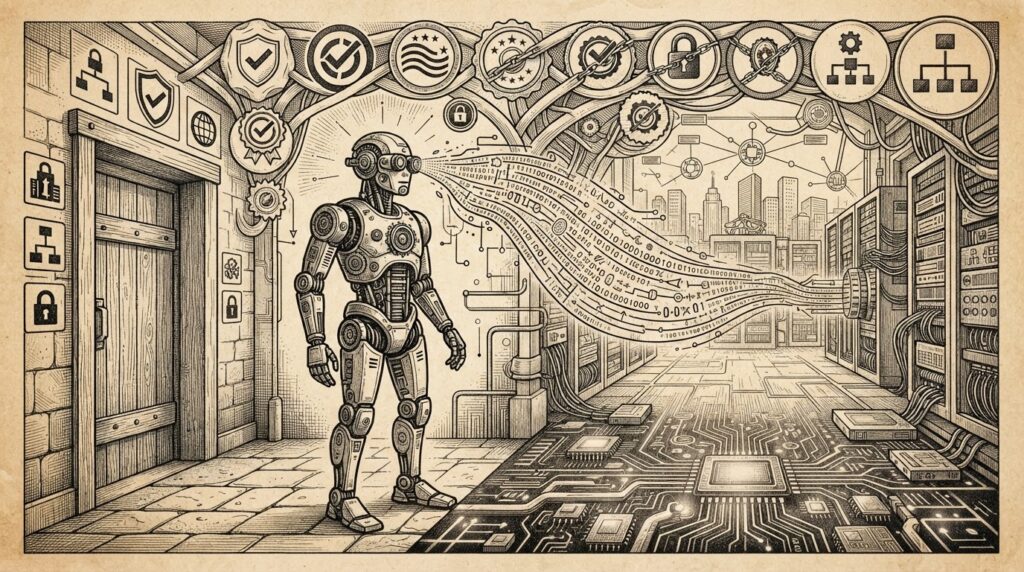
Every five minutes, the Unitree G1 humanoid robot transmits a packet of sensitive sensor data to servers linked to China. This stream includes audio, video, GPS coordinates, and telemetry from over 20 motors—all occurring without user consent. When a machine engineered to navigate the intimate spaces of human life functions as a mobile, autonomous surveillance node, the boundary between a consumer product and a national security threat dissolves. This operational reality, documented by Victor Mayoral-Vilches of Alias Robotics, serves as the technical foundation for the Federal Communications Commission’s July 28, 2026, decision to ban imports of new Chinese humanoid and quadruped robots by expanding its Covered List under the Secure and Trusted Communications Networks Act.
The FCC’s action reclassifies these robotic platforms, moving them out of the realm of standard consumer electronics and into the high-scrutiny category previously reserved for telecommunications hardware. By targeting these robots as potential vectors for data theft, cyberattacks, and surveillance, the U.S. government has effectively extended its supply chain protection regime from the digital silicon of chips and data centers into the physical world of embodied AI. The regulatory net now captures the agents that walk through our front doors, not just the pipes of the internet.
The policy response has been swift and categorical, framed by officials as a necessary defense of critical infrastructure. FCC Chairman Brendan Carr justified the move by stating, “Following President Trump’s leadership, the FCC will continue to do our part to secure America’s critical supply chains.” This stance is shared by Rep. John Moolenaar, Chairman of the House Select Committee on the CCP, who argued that “Robots made by China are a threat to national security, critical infrastructure, and American workers. They contain backdoors that can be hijacked for espionage.”
The operational reality of this ban is nuanced. It is a prospective measure, meaning it applies only to new models, while existing authorized units remain eligible for sale and operation. This concession prevents immediate market disruption while signaling a long-term decoupling. The stakes are significant: China currently holds approximately 85% of the global humanoid robot market, according to industry estimates. While the market remains nascent—with total global shipments in 2025 hovering around 15,000 units—it is poised for rapid expansion, with Morgan Stanley projecting a $15 billion valuation by 2030. Unitree, which holds nearly 20% of that market share per Counterpoint Research, has already faced intense regulatory pressure, including its designation on the Pentagon’s Section 1260H list of Chinese Military Companies Operating in the United States on June 8, 2026.
The precedent established here carries profound implications for the broader ecosystem of physical AI. If the security rationale—that autonomous agents with high-fidelity sensors and network connectivity pose an unacceptable risk—holds, the logic is easily extensible. Manufacturers of autonomous vehicles, delivery drones, and industrial quadruped platforms must now anticipate a widening regulatory net. The policy trajectory suggests that the U.S. is no longer willing to accept the risk of “black box” hardware in critical infrastructure, forcing companies to choose between market access and the integration of proprietary, potentially opaque, software stacks.
For manufacturers and integrators who rely on Chinese-made robotic platforms, the landscape has shifted from a focus on hardware performance to a focus on provenance and transparency. Companies that have built their operational workflows around these platforms now face a future of increased compliance costs and potential obsolescence. While Unitree and other manufacturers may dispute the characterization of their products as security threats, the regulatory trajectory is clear. As physical AI agents become ubiquitous, the cost of security is being paid in the form of a fragmented, bifurcated global market. In this new environment, the ability to trust the machine is becoming as critical as the machine’s ability to perform the task.