During Visa’s Q3 FY2026 earnings call on July 28, CEO Ryan McInerney positioned agentic commerce as the next major adoption curve, explicitly linking it to the historical trajectories of e-commerce, mobile payments, and tokenization. For an organization that just saw its payments volume surpass $4 trillion for the first time, this is a clear signal: Visa is betting that the next $3 to $5 trillion in addressable market volume will be initiated by non-human actors.
This strategic pivot is anchored by Visa Intelligent Commerce, an integration vehicle designed to move the company further up the value chain. While the market has spent the last year debating the merits of various settlement architectures—from crypto-native x402 rails to Mastercard’s AP4M and Google’s UCP—the reality is that the underlying settlement layer is rapidly commoditizing. As Paymentology CTO Tim Joslyn recently noted, 99% of existing issuer processing systems are already technically capable of handling agentic payments. The competitive battleground has shifted away from the rails themselves and toward the trust infrastructure required to govern them.
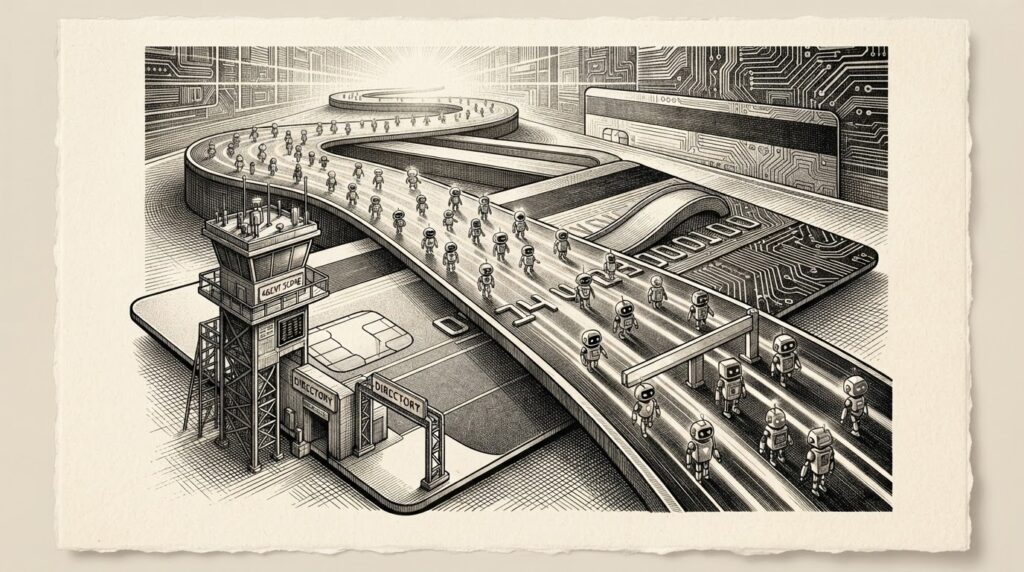
Visa’s response to this shift is concrete. By deepening its partnership with OpenAI to provide tokenized credentialing and real-time fraud monitoring for ChatGPT and Codex, Visa is attempting to solve the “permission, control, and proof” problem identified by Thredd CEO Jim McCarthy. The introduction of the Agentic Directory, Agent Score, and the Large Transaction Model represents a move to codify governance into the transaction flow. These tools are not just product features; they are the necessary plumbing for a world where the entity initiating the payment is an algorithm rather than a human.
A Product.ai survey from April 2026 revealed that only 14% of consumers trust AI to execute purchases without verification, with 42% refusing to trust agents for transactions exceeding $25. This skepticism is mirrored in the performance of early implementations. OpenAI’s own Instant Checkout in ChatGPT, which scaled back in March 2026, saw in-chat conversion rates at roughly one-third of standard on-site levels, with only about 12 Shopify merchants successfully going live.
Visa’s strategy acknowledges this friction by focusing on the “trust infrastructure” layer. The company is betting that the barrier to agentic commerce is not the lack of a payment rail, but the lack of a verifiable identity and authorization framework. By deploying Agent Score and Token Assurance, Visa is attempting to bridge the gap between the high-friction reality of current consumer sentiment and the high-volume future they are projecting to shareholders.
This approach highlights a fundamental divergence in the industry. While some players continue to iterate on the mechanics of settlement, Visa is doubling down on the governance layer. They are effectively arguing that the winner of the agentic era will not be the one with the fastest settlement, but the one that can provide the most reliable “proof” of intent and authorization. This is a defensive play against the commoditization of the rails, ensuring that even if the settlement architecture becomes a utility, the trust layer remains a proprietary, value-added service.
The contrast between the slow adoption of current agentic checkout tools and the aggressive revenue-planning signaled by Visa’s leadership is stark. It suggests that the industry is currently in the “standards phase” of the adoption curve, where the primary work is not in scaling volume, but in building the infrastructure that makes volume possible. Visa’s earnings call confirms that the company is no longer waiting for the market to mature; they are actively building the governance mechanisms required to force that maturity.
The integration of the Agentic Directory and Agent Score into the transaction flow effectively reconfigures the network from a passive settlement utility into an active gatekeeper. By embedding these governance mechanisms directly into the authorization path, Visa ensures that the network’s value is derived from its capacity to validate the legitimacy of non-human actors before capital moves, rather than simply facilitating the movement of funds.
Sources:
- Visa Q3 FY2026 Earnings Call Transcript (Seeking Alpha), July 28, 2026
- Visa Q3 FY2026 Earnings Press Release (IR), July 28, 2026
- Visa Agentic Directory / Intelligent Commerce, June 10, 2026
- PYMNTS eBook “Building the Agent-Ready Payments Enterprise,” July 2026
- Product.ai Trust in AI Commerce Report, April 2026
- The Information (OpenAI Instant Checkout retreat), March 2026
- Forkast Post 128003 (Paymentology Trust Infrastructure)