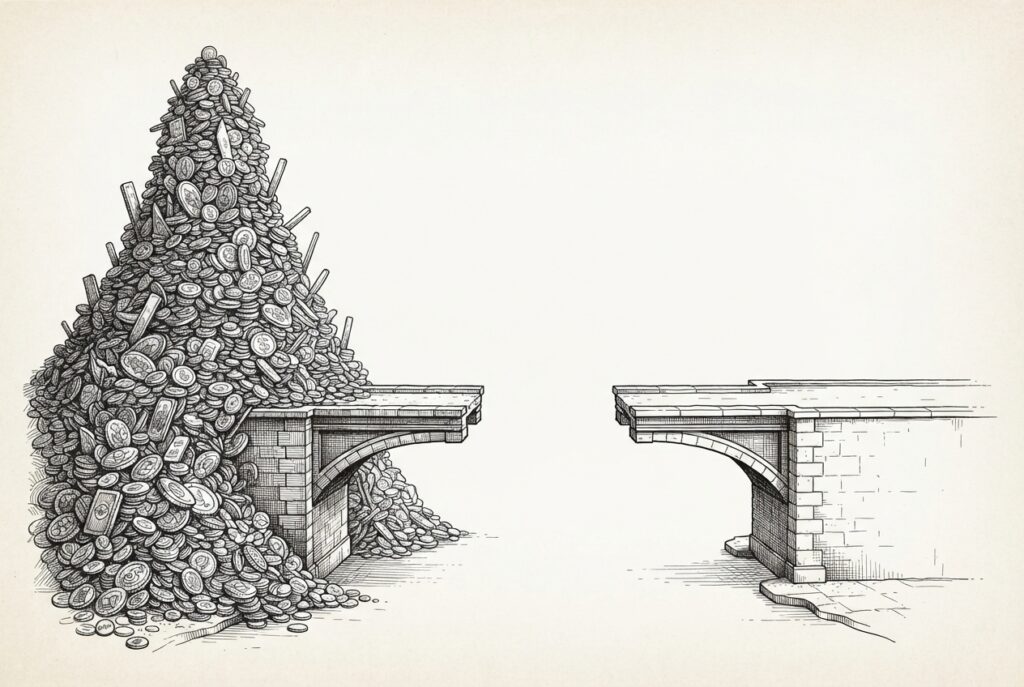
The CLARITY Act is stalled by a structural conflict between the President’s crypto-heavy financial portfolio and the ethics provisions required to attract seven Democratic votes. The obstacle is not procedural maneuvering or partisan gamesmanship. It is arithmetic.
The President’s 2025 Office of Government Ethics disclosure, released June 30, 2026, reveals approximately $1.4 billion in total crypto income. That figure comprises roughly $515 million from World Liberty Financial governance token sales, $635 million in TRUMP memecoin royalties, and between $65 million and $197 million in World Liberty Financial equity. Crypto is now the President’s dominant income source, eclipsing his combined earnings from real estate, licensing, and Mar-a-Lago — which totaled $77 million. When the executive branch is structurally tethered to the industry it is tasked with regulating, the design space for ethics legislation narrows to near zero.
The Lummis revised draft, introduced July 22, attempts to navigate this by barring presidents and officials from issuing or sponsoring digital assets while in office, with a one-year blind trust transition. The draft contains a fatal gap: it does not cover existing holdings or the licensing and transaction income already flowing to the President. By exempting the very assets that constitute the bulk of his crypto-related wealth, the bill sidesteps the conflict it needs to resolve.
The gap is not accidental. A provision that actually required divestment of $1.4 billion in existing holdings would be politically impossible for the Republican caucus to support. But a provision that exempts those holdings is structurally meaningless to the Democrats whose votes are needed. The design space offers no middle path.
The enforcement mechanism widens the deadlock. The current draft relies exclusively on Department of Justice enforcement, with fines capped at $250,000 per day. This is a non-starter for the seven pro-crypto Democrats — Gallego, Alsobrooks, Cortez Masto, Booker, Hickenlooper, Warner, and Warnock — who rejected the ethics provision as falling short on conflicts of interest, consumer protection, and market integrity.
Senator Angela Alsobrooks, who voted for the bill in committee, put it plainly: “They’re completely unserious. A lawless Department of Justice cannot oversee this.” Representative Ruben Gallego was blunter. Senator Chris Van Hollen called the provision “woefully inadequate” and warned it would allow the President to “continue profiting from crypto corruption.” The divide runs along a clean structural line: Democrats demand state attorney general involvement; Republicans, led by Senator Bernie Moreno, insist on DOJ-only enforcement. There is no compromise position between these two architectures.
The market has priced in the impasse. Polymarket year-end odds for the CLARITY Act cratered from 82% in February to roughly 38% by late July, hitting a record low of 31% on July 25. Galaxy Research pegs passage at 50-50. Kalshi prices a pre-recess vote at roughly 40%. Senate Majority Leader Thune has publicly doubted the possibility of passage before the August 7–10 recess deadline.
The President’s family has earned approximately $2.3 billion in cumulative crypto income since returning to the White House, according to Reuters. The administration’s position has been consistent: the White House states that neither the President nor his family has engaged in conflicts of interest, and the President himself asserted on July 2 that “there’s nothing wrong with it — I was there before I was in office.” Meanwhile, World Liberty Financial’s application for an OCC national trust bank charter — which would allow it to issue and custody the USD1 stablecoin — remains pending, with former agency officials expecting approval.
The CLARITY Act’s failure is structural. For the bill to reach 60 votes, it would need to simultaneously satisfy a Republican caucus that cannot support divestment of the President’s existing holdings and a Democratic caucus that will not accept an ethics provision that exempts them. The math does not work, and until the conflict of interest is reconciled rather than papered over, the bill remains stalled.