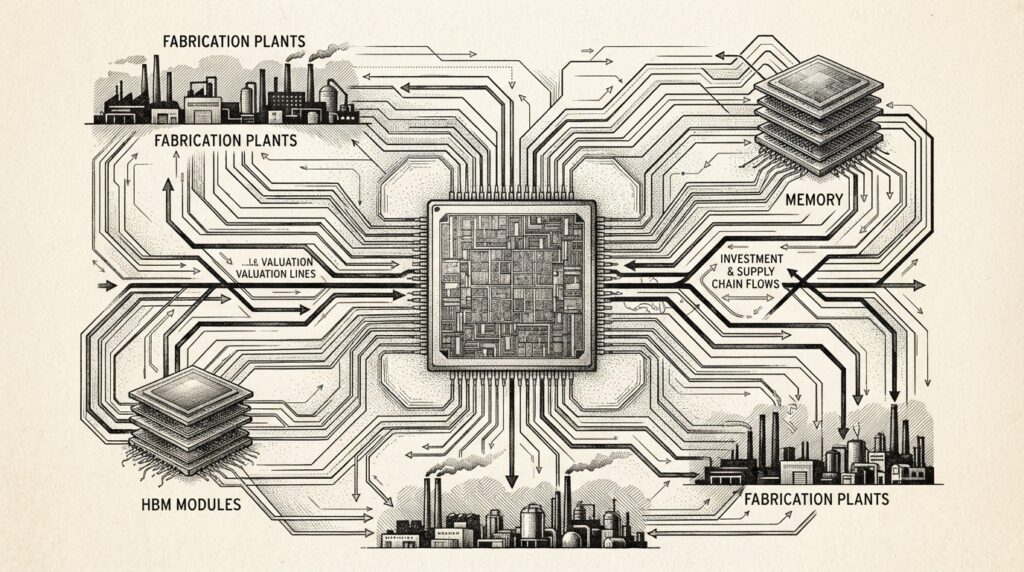
Etched’s $10.3 billion valuation, achieved without shipping a single rack of hardware, marks a shift from pricing products to pricing a thesis. On July 23, the San Jose-based startup closed a $300 million Series C led by Sequoia at that figure-a number the company claims is the highest valuation ever for a Sequoia-led Series C. Total funding now stands at roughly $1.1 billion across four rounds. The question the market is answering with this capital is not whether Sohu, Etched’s inference chip, works. It is whether the compute supply chain can survive without something like it.
At the center of the bet is an ASIC designed specifically for transformer-based inference. Etched projects Sohu will deliver 20x the throughput of an Nvidia H100 on transformer workloads. Those figures are company projections only-there are no independent benchmarks, and the chip has not shipped at scale. First racks are scheduled for summer 2026. What has shipped is momentum: the company moved from a $5 billion valuation in December 2025 to $10.3 billion in seven months, and it has already booked $1 billion in customer pre-orders before delivering production hardware.
The investor roster tells a more specific story than the valuation alone. Beyond Sequoia and Andreessen Horowitz, SK Hynix participated in the round. SK Hynix is the dominant global supplier of High Bandwidth Memory, the component that determines how much data an AI chip can move per second. As both supplier and equity investor, SK Hynix is signaling that it sees Etched not as a customer but as a channel-one that could anchor its HBM roadmap to a new class of specialized inference hardware. COO Robert Wachen framed the strategy directly: “We’re deep believers in vertical integration. It’s not enough to build a chip… you have to build a machine that can produce the best clusters in the world at gigawatt scale.”
The demand signal reinforces the supply-side logic. One billion dollars in signed contracts before first delivery is unusual even in a market accustomed to pre-commitments. Private demos have been conducted for Andrej Karpathy, Noam Brown of OpenAI, and Geoffrey Hinton-luminaries whose endorsement carries weight precisely because they have no financial obligation to say the hardware works. Etched now employs over 400 people and operates a 2MW data center in San Jose alongside a new 10MW facility in Milpitas, all fabricated on TSMC’s 4nm N4P process.
The timing matters. TSMC’s Q2 earnings confirmed that the compute squeeze is expanding beyond GPUs into the broader supply chain. AMD’s Advancing AI keynote showed specialized hardware challenging GPU inference dominance at the rack level. The $5 billion AMD-Anthropic deal underscored a market-wide push to diversify compute dependencies away from a single-vendor ecosystem. Etched is positioning Sohu as the logical endpoint of that diversification: purpose-built silicon for the layer where demand is growing fastest-inference.
The risks are structural. Etched’s entire value proposition rests on the bet that transformer attention remains the dominant inference paradigm. If the research landscape shifts toward architectures that Sohu cannot serve efficiently, the fixed-function silicon loses its edge. Wachen has stated that Sohu can run Mixture-of-Experts models like DeepSeek and Qwen, as well as state-space models like Mamba-a claim that, if validated, would significantly broaden the chip’s addressable workload. But that validation has not happened. The gap between what the company promises and what independent testing confirms remains the central uncertainty.
There is also a second track. The Wall Street Journal reported on July 17 that Etched was separately in talks to raise at a $20 billion valuation in a round led by Jane Street-suggesting the company is running two fundraising lanes simultaneously. If both close, the total capital raised would exceed $1.5 billion on a chip that has yet to appear in a production benchmark.
The $10.3 billion is not a reflection of output. It is a wager that the current compute squeeze is a permanent feature of the AI landscape, and that the path to efficiency runs through hardware designed for one job rather than adapted for many. Wachen acknowledged the distance between the bet and the proof: “I think we still have to be humbled by what it will take to actually get to scale.” The gap between $10.3 billion and gigawatt-scale delivery is where the story actually lives.