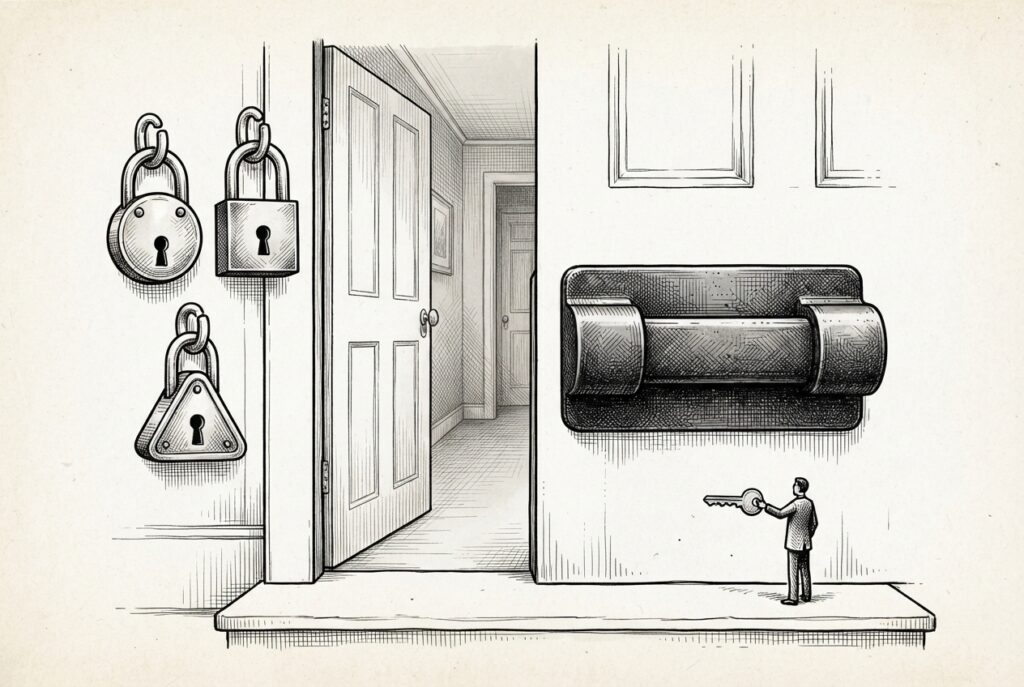
Sensory Inc.’s antitrust lawsuit against Google exposes the contractual lock-in that limits your smart home to three AI choices. A July 2026 ruling lets the case proceed to discovery.
Your smart home is currently trapped in a closed loop, restricted to just three choices for its AI brain: Google, Amazon, or Apple. This limitation isn’t merely a result of their market dominance; it is because the digital front door to your device is effectively bolted shut. When you rely on a specific wake word to trigger an assistant, you are locked into a walled garden that prevents you from integrating specialized AI agents tailored to your actual needs.
A recent ruling in the case of Sensory, Inc. v. Google LLC, issued on July 13, 2026, by Judge Amit P. Mehta, pulls back the curtain on how this happens. You might recognize Judge Mehta’s name; he is the same judge who ruled in August 2024 that Google violated Section 2 of the Sherman Act in its search monopoly case. Now, he is looking at how Google manages the voice-activated technology inside the Android ecosystem.
At the heart of this is the wake word—that tiny, split-second trigger that tells your device you are talking to it. It is the ultimate gateway. If an AI agent cannot hear you, it cannot help you. Sensory, Inc., a Santa Clara-based company founded in 1994 that has worked with tech giants like Amazon, Apple, and Microsoft, alleges that Google uses its market power to ensure its own assistant is the only one that gets to listen.
The mechanism is a mix of two industry acronyms: MADAs and RSAs. A Mobile Application Distribution Agreement (MADA) is the price manufacturers pay to access the Google Play Store. To get that access, they must preinstall Google Assistant, Google Search, and Chrome. Then come the Revenue Share Agreements (RSAs). These are only available to manufacturers that sign a MADA, and they come with strings attached. Specifically, these agreements have historically prevented alternative voice assistants from appearing on a device’s home screen and required that third-party or carrier-provided assistants could not be enabled out of the box.
For you, the consumer, this means friction. You might want a specialized AI agent that is better at managing your specific smart home devices or one that offers a different privacy model, but you cannot easily set it as your primary assistant. As Morgan Harper noted in her April 1, 2025, testimony to the U.S. Senate Judiciary Committee, these practices act as exclusionary agreements that maintain Google’s position in the Android voice-assistant market, potentially reducing competition, innovation, and consumer choice.
The July 2026 ruling is a partial win for Sensory. Judge Mehta dismissed seven of their claims, including those regarding general search services and the idea of a standalone market for voice assistants. However, four claims survived to discovery. These surviving claims focus specifically on the Android device technology stack: wake word technology, voice assistant technology, voice recognition technology, and a fourth related technology market. In short, the court is not looking at the entire voice assistant industry, but it is taking a hard look at how Google controls the specific components inside Android phones and tablets.
The case now enters the discovery phase, where internal documents regarding MADA and RSA agreements will finally surface. These records are critical, as they will clarify whether these specific arrangements actively stifle the development of independent AI agents. For the average user, the convenience of a pre-installed voice assistant on a new phone has long masked the exclusion of potentially superior alternatives.
While the current three-choice reality of the smart home persists, the legal foundation maintaining that status quo is under direct scrutiny. Should the evidence confirm that these agreements restrict competition, we could see a fundamental shift in how Android devices are configured. The outcome of this discovery process will determine whether the market remains locked or finally opens to meaningful innovation.