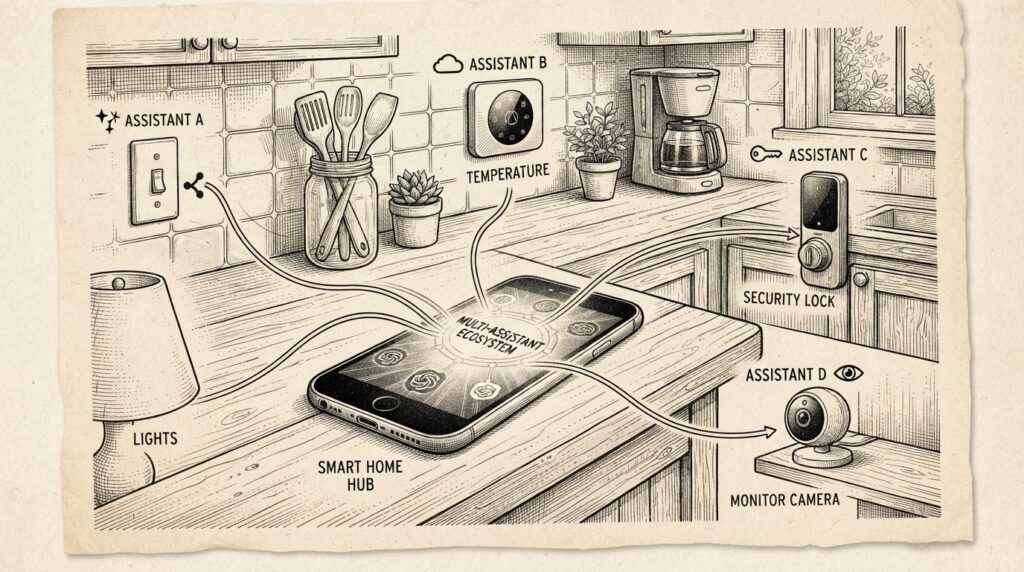
You are standing in your kitchen on a Tuesday morning, coffee in hand, trying to get your smart home to cooperate. You tell your phone to dim the lights, lock the front door, and check the weather. Right now, that usually means talking to Google Assistant. It is a familiar, if occasionally frustrating, dance. But thanks to a recent decision from the European Commission, that dynamic is about to get a lot more crowded.
On July 15 and 16, 2026, the EU issued two sets of binding specification measures to Google under the Digital Markets Act. The goal is to force Google to open up the deep, system-level parts of Android to rival AI assistants. This is not just another dry antitrust ruling; it is a fundamental reframe of how your phone acts as the brain of your house. By opening up 11 specific Android features—ranging from long-press activation and always-on hotword detection to centralized app data and screen automation—the EU is effectively turning your phone into a neutral control surface for any AI you choose, rather than just the one Google pre-installed.
For those of us who have spent years cobbling together smart home routines, this is a significant shift. Currently, if you want a different AI to handle your home, you are often stuck with a clunky app that lacks the deep integration Google enjoys. Under these new rules, rival assistants will gain access to context-aware intelligence and system-level integration. An AI assistant can now see your screen, understand your app data, and proactively suggest actions across your entire device. It means your preferred AI could soon control your lighting, security, climate, and media with the same level of responsiveness we currently expect from Google.
This change arrives at a time when the market for these technologies is massive. The global voice control smart home market was valued at $14.8 billion in 2025, while the broader AI in smart home technology sector reached $18.47 billion. European regulators are clearly looking to ensure this growth remains competitive. Teresa Ribera, Executive Vice-President for Clean, Just and Competitive Transition, noted: “Society is going through a profound digital transformation. We need to keep that process fair and ensure that our citizens have choice. Our decision will help smaller competitors, search engines, or AI assistants, to compete and provide that choice, while protecting the user’s privacy.”
Henna Virkkunen, Executive Vice-President for Tech Sovereignty, Security and Democracy, echoed this sentiment, stating: “With today’s measures, we want to support innovation and diversity in the European Union, enabling fair competition in the markets of AI assistant for Android devices and search engines.”
The rollout is staggered. You can expect 10 of these features to arrive with Android 18 by August 1, 2027. The big one—always-on hotword detection—is deferred until Android 19, due by August 1, 2028. While this is an EU-only mandate, the sheer scale of the Android ecosystem—which accounts for about 60% of users in Europe—means these changes will likely ripple out globally as developers adjust to the new reality.
Google is not exactly thrilled about this. Kent Walker, the company’s President of Global Affairs, pushed back hard, stating: “Today’s decisions risk undermining vital privacy and security guardrails for millions of Europeans. We have repeatedly offered solutions to safeguard users while satisfying the DMA’s goals, but these rulings discount extensive evidence of user harm.” It is a familiar corporate stance, framing the opening of their platform as a threat to the safety of the very people using it. Whether that concern holds water or is simply a way to protect their turf is the central tension of this entire transition.
Before you get too excited about a total smart home overhaul, keep your expectations grounded. The DMA does not directly open Nest or Google Home hardware to third-party assistants. If you have a house full of Nest thermostats and cameras, this ruling does not magically make them play nice with a competitor’s AI. The DMA is about the phone’s operating system, not the physical devices on your wall. The actual impact will be limited by existing app permissions, APIs, and how well your chosen AI assistant can actually talk to your specific smart devices. While the Matter protocol may complement this change, it remains a separate mechanism.
For the average user, the competition is shifting. It is no longer just about which app you download from the store. It is about which AI gets to live in the background of your phone, listening for your voice and managing your digital life. We are moving toward a world where your phone is a more flexible tool, but the real test will be whether these rival assistants can actually deliver a better experience than the one we have been using for years.