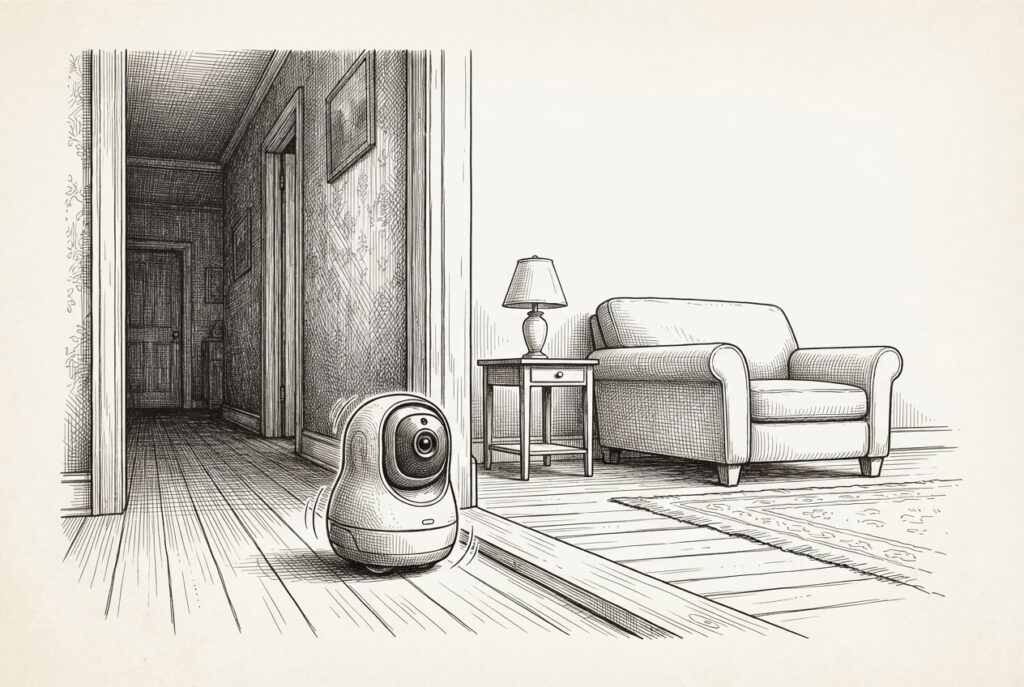
You are sitting on the couch, scrolling through your phone, when you hear a soft whirring sound from the hallway. It is not the vacuum, and it is not the cat. It is your smart speaker, which has decided that the lighting in the living room is suboptimal for your current mood and has rolled itself a few feet closer to the window to recalibrate. This is the reality OpenAI is aiming for with its upcoming portable, screenless smart speaker. Designed in partnership with Jony Ive’s LoveFrom studio, the device is meant to be a humanlike AI companion that does not just sit on a shelf, but actively navigates your home using cameras and sensors to manage your life.
The promise here is total orchestration. By plugging into your emails and learning your daily rhythms, the device aims to handle everything from energy management to health signals. But there is a catch that feels impossible to ignore: we are moving from static voice assistants to a mobile, camera-equipped agent that has full access to our most private digital correspondence. This is a massive escalation in the privacy calculus. According to a 2025 NIST survey, voice assistants are already ranked as the most problematic device category for security and privacy. Adding autonomous movement and visual perception to that existing friction point creates a level of consumer anxiety that the industry has yet to address.
It is easy to see why people are hesitant. Data from Copeland shows that 70% of consumers would happily swap out their current smart thermostat for a brand that actually prioritizes security. That same data reveals that 55% of owners have little to no understanding of how their device data is used, and only 8% bother to research privacy policies before buying. We are currently operating in a market where the global smart home sector is worth $207 billion and autonomous AI is hitting $22.66 billion, yet the average user is flying blind. As Brendan O’Toole, VP of Smart Home and Energy Management at Copeland, puts it: “Companies can treat privacy as a design constraint to be optimized away or as a foundational requirement for growth, but only one of those paths allows the category to scale in a meaningful way.”
The path to getting this device into your living room is also hitting some very real, very public speed bumps. Apple filed a lawsuit against OpenAI on July 10, 2026, in the U.S. District Court for the Northern District of California, alleging the misappropriation of trade secrets. The list of defendants is telling, including former Apple hardware executives Tang Yew Tan and Chang Liu. Because Tang Yew Tan was so deeply involved in OpenAI’s hardware efforts, this legal battle is not just a corporate headache; it is a material constraint on the development timeline. While some reports have floated a price point between $200 and $300, others, like AI Chat Daily, have noted that no price is confirmed, and the legal fallout makes a February 2027 release date look increasingly optimistic.
Even if the hardware clears the courtroom, there is a massive regulatory void waiting on the other side. The EPIC Beyond HIPAA report from January 2026 makes it clear that our current privacy regulations are entirely inadequate for AI companions that collect sensitive personal and health-related data inside the home. We are essentially being asked to trust the manufacturer’s goodwill because there are no enforceable standards to protect us from a device that watches, listens, and moves through our most private spaces. When you centralize control of your home’s most sensitive data into one mobile agent, the impact of a potential security breach becomes exponentially larger than it would be for a single, isolated device.
Ultimately, the household of the near future faces a quiet, persistent choice. We are being sold a level of convenience that promises to orchestrate our lives, but the cost is a device that requires us to surrender a new layer of domestic autonomy. Whether this becomes a genuinely helpful companion or just another persistent privacy risk depends on whether these companies can stop treating security as an afterthought and start building it as a foundation. Until then, that whirring sound in the hallway might feel less like a helpful assistant and more like an uninvited guest.