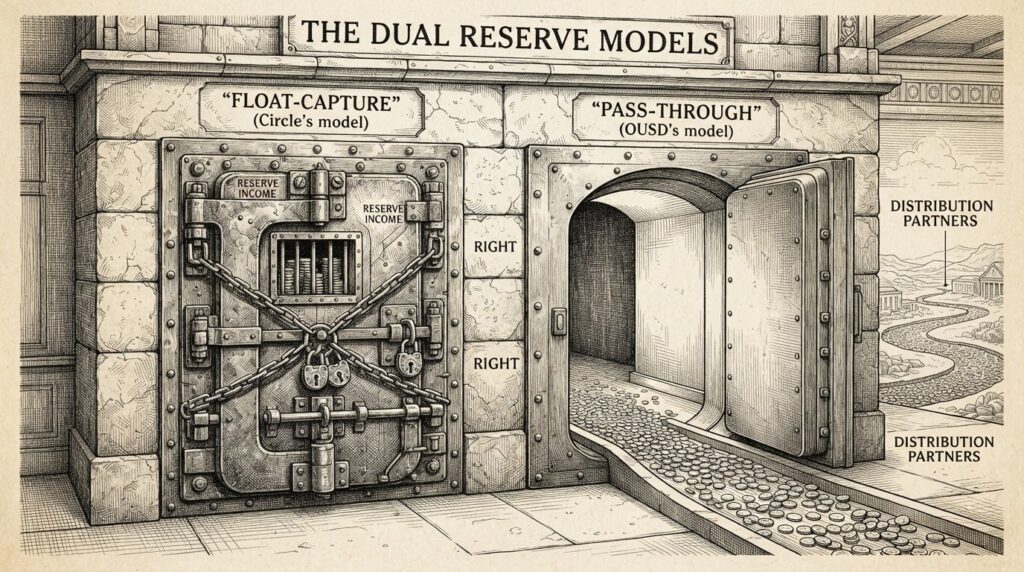
The stablecoin industry is currently defined by a quiet, structural war over who gets to keep the interest earned on the trillions of dollars in idle capital backing digital assets. For years, the dominant business model has been the float-capture approach, where issuers like Circle retain the bulk of reserve income, sharing only a portion with distribution partners. But a new challenger, the Open USD (OUSD) consortium, is proposing a radical inversion of this logic: a pass-through model that routes nearly all reserve income directly to the distributors themselves. This shift in plumbing is the primary reason Mizuho analyst Dan Dolev downgraded Circle (CRCL) to Underperform on July 14, 2026, cutting his price target from $85 to $50.
Dolev is the first analyst to explicitly name this structural threat, arguing that the OUSD model could fundamentally alter Circle’s business. The contrast is stark. Circle’s current model relies on retaining a significant portion of the treasury yield generated by its reserves to drive revenue. Under its August 2023 agreement, Circle shares roughly 50% of residual income with Coinbase, while retaining the rest. In contrast, the OUSD consortium — which includes heavyweights like Visa, Mastercard, BlackRock, and Google — intends to route nearly all reserve income to its partners after a nominal management fee. These partners, in turn, are expected to compete to deliver that yield to end users through various mechanisms like DeFi rewards, lending boosts, or wallet cashback.
This structural pivot is designed to navigate the GENIUS Act, which prohibits stablecoin issuers from paying interest directly to holders. By routing the yield through third-party distributors, OUSD effectively sidesteps the restriction while turning the stablecoin into a competitive yield-generation tool for the partners themselves. The pressure on Circle is compounded by the fact that Coinbase, its largest distribution partner, is also a founding member of the OUSD consortium. With the current Coinbase revenue-sharing agreement set to reach a critical inflection point in August 2026, the market is beginning to scrutinize the sustainability of Circle’s margins. In fiscal year 2025, Circle’s distribution costs hit $1.4 billion, or roughly 51% of its revenue, and in the first quarter of 2025, Coinbase earned approximately $300 million from Circle — a figure that actually exceeded Circle’s own net income of $230 million.
The threat posed by OUSD remains theoretical for now. The consortium, announced on June 30, 2026, has not yet launched its stablecoin, with a release date currently slated for later in 2026. Circle also possesses a significant countervailing force in the form of its federal bank charter. On July 10, 2026, Circle became the first stablecoin issuer to receive an OCC charter as a National Trust, granting it the ability to manage reserves under direct federal oversight. This regulatory moat provides a level of institutional legitimacy and security that the OUSD consortium has yet to replicate. The market’s reaction to the Mizuho downgrade reflects this tension; while CRCL shares initially dropped 3.7% on July 14, they quickly bounced back, trading between $65 and $66 by the following day, suggesting that investors have not yet fully priced in the long-term structural risk.
The financial community is currently weighing a known, high-margin business model against a potential, low-margin, high-volume future — an edge case that defines the current market tension. Circle’s Q1 2026 results showed 20% year-over-year revenue growth, but this was tempered by a 66-basis-point decline in the reserve return rate, highlighting the sensitivity of the float-capture model to interest rate fluctuations. Mizuho’s bearish outlook, which includes raising assumed distribution and transaction costs to 73% of revenue for fiscal year 2027 and cutting adjusted EBITDA to $699 million — well below the Wall Street consensus of $941 million — is a bet that the industry is moving toward a commodity-like utility model. The market’s eventual verdict hinges on OUSD’s ability to execute its pass-through strategy at scale.