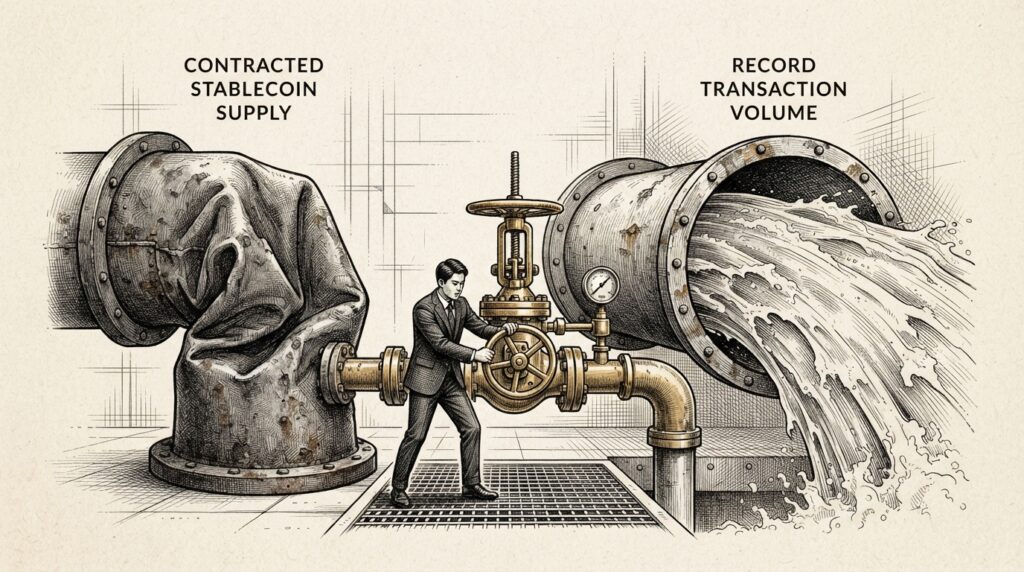
The narrative of stablecoin contraction is increasingly decoupled from the reality of institutional utility. While Q2 2026 marked the first quarterly decline in total stablecoin supply since Q3 2023 – a contraction of more than $3 billion – the underlying infrastructure is processing record volume. June 2026 saw $1.79 trillion in adjusted stablecoin transaction volume, a record high according to Visa data. This divergence suggests that market participants are prioritizing high-velocity, low-friction settlement rails over the aggregate circulating supply.
Hyundai Card’s recent intercompany transfer serves as a primary proof point for this shift. On July 9-10, 2026, the firm executed the first production-ready stablecoin transfer by a major Korean conglomerate, moving $20,000 USDT on the Avalanche C-Chain from Hyundai Motor America to Hyundai Motor Mexico. The transaction settled in approximately seven minutes, a significant reduction from the three to four hours typically required by traditional correspondent banking. Justin Kim, Head of APAC at Ava Labs, noted the significance of this transition:
“This is already a real treasury management use case, not a sandbox – the pilot moved live USD and USDT between Hyundai Motor’s U.S. and Mexico entities.”
The pilot, developed with Swiss-based infrastructure provider Axiym, highlights how firms are navigating multi-jurisdictional flows. The current approach utilizes USDT for liquidity in emerging markets, where it accounts for approximately 66% of global supply, while positioning for USDC-based integration in regulated corridors, where USDC captures 70% of transaction volume. Hyundai plans to expand this model in late July 2026, moving to a second phase involving European subsidiaries that will utilize Circle’s USDC and partner with Visa to test multi-currency transfers. A Hyundai Card official emphasized the operational shift:
“This PoC is significant because it shows that we have moved beyond a simple technical test and completed preparations for potential real-world adoption.”
Despite these developments, adoption remains constrained by geography and regulatory friction. The pilot is currently limited to intercompany treasury transfers rather than consumer-facing remittances. Furthermore, the regulatory environment in South Korea presents a significant hurdle. The Digital Asset Basic Act, currently under review by the National Assembly, is the most restrictive of three competing bills, requiring foreign issuers to maintain a local branch and secure an FSC license. This creates a complex legal landscape for firms attempting to integrate global stablecoin rails into domestic treasury operations.
The trajectory for B2B cross-border stablecoin payments remains substantial, with projections estimating the sector could reach approximately $5 trillion by 2035. As institutional actors continue to treat stablecoins as a functional settlement layer, the divergence between asset supply and transaction velocity is likely to persist. This trend forces traditional financial institutions to modernize their own cross-border offerings to remain competitive in a high-velocity treasury environment.